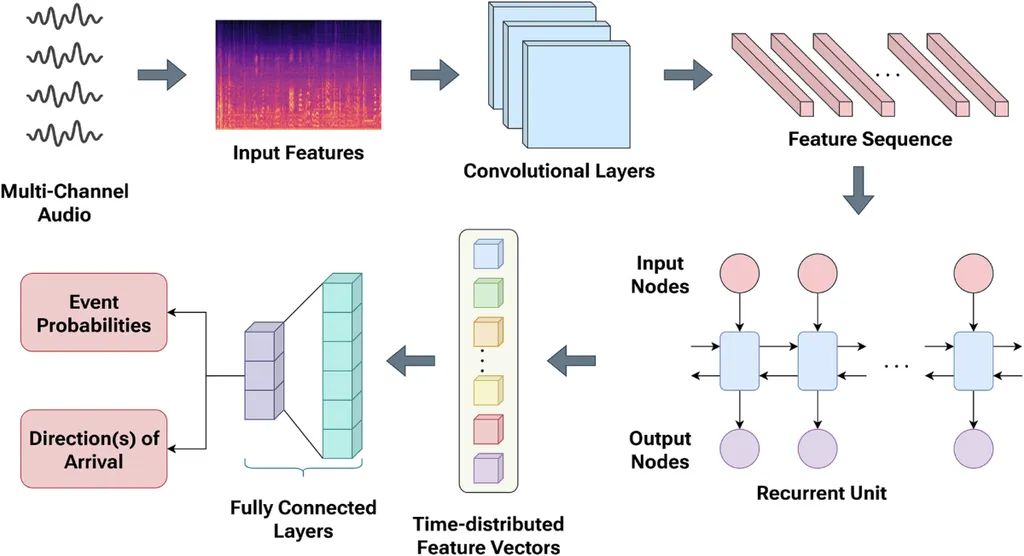
In the ever-evolving landscape of audio technology, researchers are constantly pushing the boundaries of what’s possible. A recent study has introduced an innovative approach to sound event localization and detection (SELD) that could revolutionize the way we interact with audio in low-resource scenarios. The research, led by Ya Jiang and a team of experts, focuses on the fusion of audio and visual information to enhance SELD capabilities.
The team’s approach is twofold. First, they propose a cross-modal teacher-student learning (TSL) framework. This method leverages the power of an audio-only teacher model, trained on a vast collection of audio data with multiple augmentation techniques, to transfer knowledge to an audio-visual student model. The student model, trained with a limited set of multi-modal data, benefits from the teacher’s extensive learning, thereby improving its performance in SELD tasks.
Secondly, the researchers introduce a two-stage audio-visual fusion strategy. This strategy consists of an early feature fusion and a late video-guided decision fusion. By combining these two stages, the model can exploit the synergies between audio and video modalities more effectively. The early feature fusion allows the model to integrate audio and visual information at the feature level, while the late video-guided decision fusion uses visual information to refine the final decisions made by the model.
To further enhance the model’s performance, the team developed an innovative video pixel swapping (VPS) technique. This method extends the traditional audio channel swapping (ACS) technique to the audio-visual domain, providing an additional layer of data augmentation that helps the model generalize better to unseen data.
The effectiveness of these techniques was demonstrated on the Detection and Classification of Acoustic Scenes and Events (DCASE) 2023 Challenge dataset. The results showed significant improvements in SELD performances, highlighting the potential of audio-visual information fusion in low-resource scenarios. Moreover, the team’s submission to the SELD task of the DCASE 2023 Challenge secured the first-place rank, further validating the efficacy of their proposed methods.
This research not only advances the field of audio technology but also opens up new possibilities for applications in various domains. From enhancing smart home devices to improving surveillance systems, the ability to accurately localize and detect sound events in low-resource scenarios is invaluable. As we continue to explore the synergies between audio and visual information, we can expect even more innovative solutions that will shape the future of audio technology.