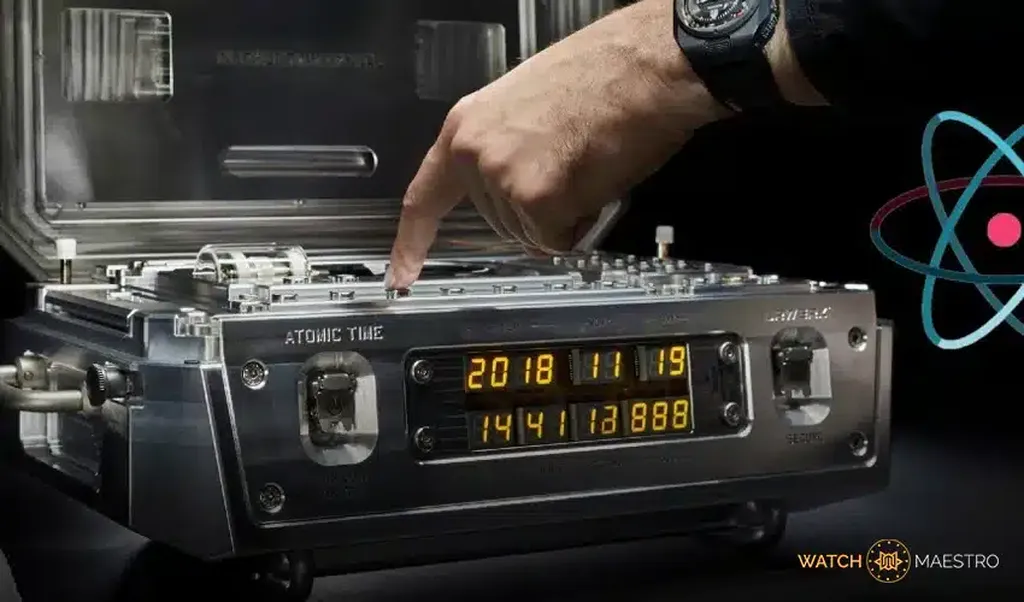
In the world of precise timing, atomic clocks are the gold standard. They’re used in everything from GPS systems to telecommunications, ensuring that our modern, interconnected world stays in sync. But what if we could make these clocks even smaller, more efficient, and less prone to drift? That’s the promise of chip-scale atomic beam clocks, and a recent study has taken a significant step forward in addressing one of their key challenges: Doppler shifts.
Doppler shifts are a phenomenon that occurs when there’s a relative motion between a light source and an observer, causing the light’s frequency to shift. In the context of atomic clocks, this can be a problem because it introduces errors that affect the clock’s accuracy. The research team, led by Alexander Staron and including Gabriela Martinez, Nicholas Nardelli, Travis Autry, John Kitching, and William McGehee, tackled this issue head-on using a centimeter-scale atomic beam clock based on rubidium-87 atoms.
The team discovered a fascinating interplay between Doppler shifts and another type of shift called resonant light shifts. These light shifts occur when the atoms in the clock interact with the laser light used to probe them. The researchers found that these two types of shifts can actually compete with each other, creating a situation where their effects can cancel each other out.
This competition between Doppler and resonant light shifts is what allowed the team to demonstrate a clock that’s insensitive to laser frequency variations. In other words, they’ve found a way to make the clock’s performance less dependent on the precise frequency of the laser light used in its operation. This is a big deal because it means the clock can maintain its accuracy even if the laser light fluctuates slightly.
The team also showed that their clock could achieve white-noise-limited frequency averaging for up to 1000 seconds of integration. This means that the clock’s performance is limited only by the fundamental noise present in the system, rather than by systematic errors or other sources of instability. This is a significant improvement over existing chip-scale atomic clocks, which often suffer from drift and other sources of error.
So, why does this matter for the future of music and audio technology? Well, precise timing is crucial in many areas of audio production and playback. For example, digital audio workstations (DAWs) rely on accurate timing to ensure that audio tracks are played back in sync. Similarly, high-resolution audio formats require precise timing to maintain the integrity of the audio signal.
As we move towards an increasingly interconnected world, where audio data is transmitted and processed in real-time, the need for precise timing will only grow. Chip-scale atomic beam clocks, with their potential for low power consumption and high stability, could play a crucial role in meeting this need. The research by Staron and his team is a significant step forward in realizing this potential, and it’s an exciting development for anyone interested in the future of audio technology.