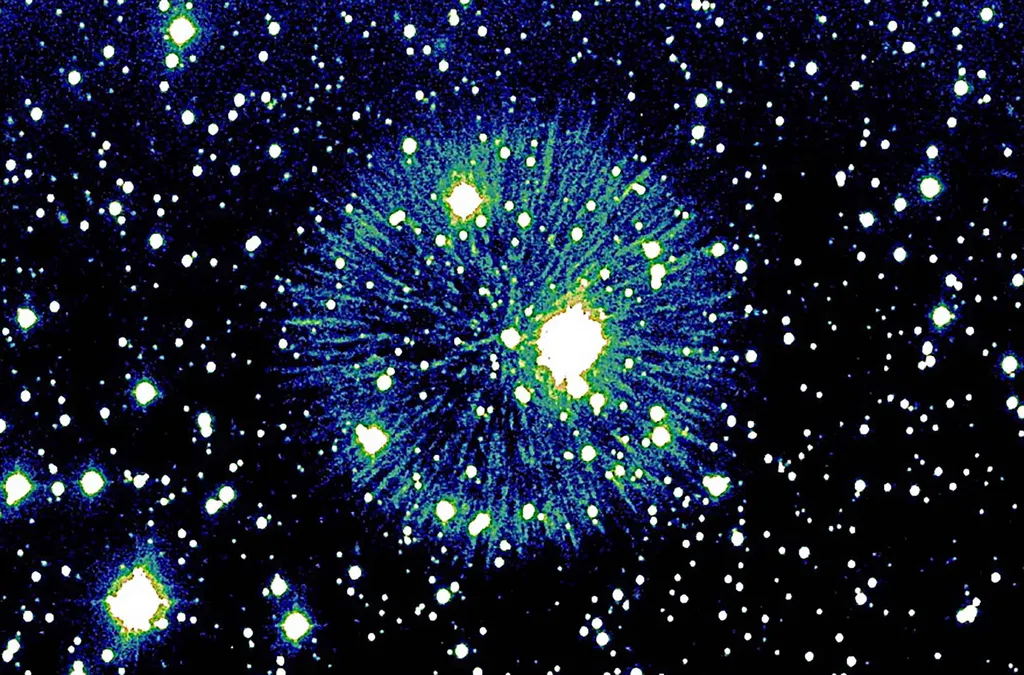
In a fascinating study that bridges the realms of astrophysics and fluid dynamics, researchers Eric R. Coughlin, Greg Salvesen, and Dheeraj R. Pasham have proposed an intriguing explanation for the unique, firework-like structure of the supernova remnant Pa 30. This remnant is believed to be the aftermath of the Galactic type Iax supernova that lit up the skies in 1181 AD.
Pa 30’s striking morphology is characterized by radial filaments that extend outwards from a central point, where a white dwarf (WD) is currently driving an extremely fast wind. The researchers suggest that these filaments were born out of the Rayleigh-Taylor instability (RTI) at the interface between the circumstellar medium (CSM) and the shocked wind launched by the natal white dwarf.
The RTI is a well-known phenomenon in fluid dynamics that occurs when a heavy fluid is accelerated into a lighter one, leading to the formation of characteristic patterns and structures. In the case of Pa 30, the researchers propose that the filaments were able to elongate and remain intact due to the Kelvin-Helmholtz stable nature of the large initial density contrast between the wind and the CSM, as well as the slowly declining wind density profile.
To support their interpretation, the researchers presented two-dimensional hydrodynamical simulations that accurately reproduced the observed properties of the filaments, including their speed, density, and temperature. They suggest that the filaments continue to elongate until the wind and CSM densities become comparable at the contact discontinuity, which occurs within 1-10 years, at which point the RTI halts and the filaments truncate.
The researchers also note that the filament-less central region in Pa 30 is more likely a consequence of the finite timescale over which the RTI operates, rather than a wind termination shock. This finding has important implications for our understanding of the late-stage evolution of supernovae and the role of instabilities in shaping their remnants.
In general, the researchers suggest that firework-like filaments may form in other systems, provided there is a sufficiently large density contrast between the ejecta and its surroundings. This opens up exciting avenues for further research and could lead to a better understanding of the complex interplay between fluid dynamics and astrophysical phenomena.