
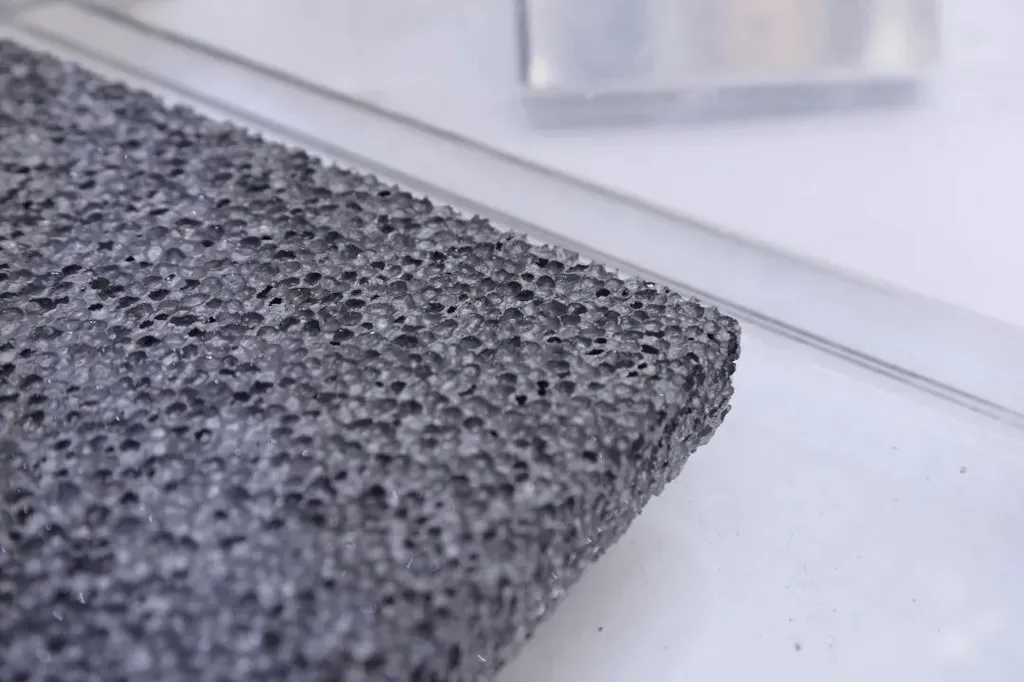
In the realm of sound absorption technology, the quest for effective materials is a critical challenge for both machine-building and civil engineering. Traditional porous materials have long been the go-to solution due to their non-flammable and non-hygroscopic properties, making them ideal for noise suppression, particularly in transportation. The absorption of acoustic energy in porous metals primarily occurs through viscous friction, a process that has been theoretically described using the classical Rayleigh model and more recently refined by the Johnson-Champoux-Allard model. Despite these advancements, achieving high sound absorption rates with aluminum foam—a cost-effective porous metal—has proven challenging. Previous attempts to enhance aluminum foam’s sound absorption by rolling or heat treatment have yielded results that barely surpass 80%, significantly trailing behind conventional materials like glass-wool, which can achieve absorption rates of up to 99.9% across a wide frequency range. The core issue lies in the substantial reflection of acoustic waves from the surface of the foamed metal, which hampers its overall effectiveness.
Researchers Arcady Finkelstein, Eugene Furman, Dmitry Husnullin, and Borodianskiy Konstantin have been at the forefront of addressing this problem. Their work delves into the intricate details of sound absorption mechanisms in porous metals, aiming to bridge the gap between traditional materials and the potential of aluminum foam. By understanding the fundamental principles of viscous dissipation within porous media, they seek to develop innovative solutions that can enhance the performance of aluminum foam. The ultimate goal is to create a material that not only matches but potentially surpasses the absorption capabilities of conventional materials, thereby revolutionizing the field of acoustic engineering.
The implications of this research extend beyond theoretical advancements. In practical terms, improving the sound absorption properties of aluminum foam could lead to significant innovations in noise control across various industries. From enhancing the acoustic comfort in vehicles to reducing noise pollution in urban environments, the potential applications are vast. Moreover, the development of more effective sound-absorbing materials could pave the way for new design possibilities in architecture and engineering, where noise reduction is a critical factor. As the research progresses, it holds the promise of transforming the way we approach sound absorption, making our environments quieter and more conducive to well-being.