
In the ever-evolving landscape of audio technology, researchers are constantly seeking innovative ways to improve self-supervised learning (SSL) models. A recent study by Kohei Yamamoto and Kosuke Okusa introduces Aliasing-aware Patch Embedding (AaPE), a novel approach that addresses a significant challenge in transformer-based audio SSL models.
Traditionally, these models treat spectrograms as images, applying convolutional patchification with heavy temporal downsampling. While this process lowers the effective Nyquist frequency, it also introduces aliasing and removes task-relevant high-frequency cues, which can be detrimental to the model’s performance. AaPE aims to mitigate these issues by preserving high-frequency information while reducing aliasing.
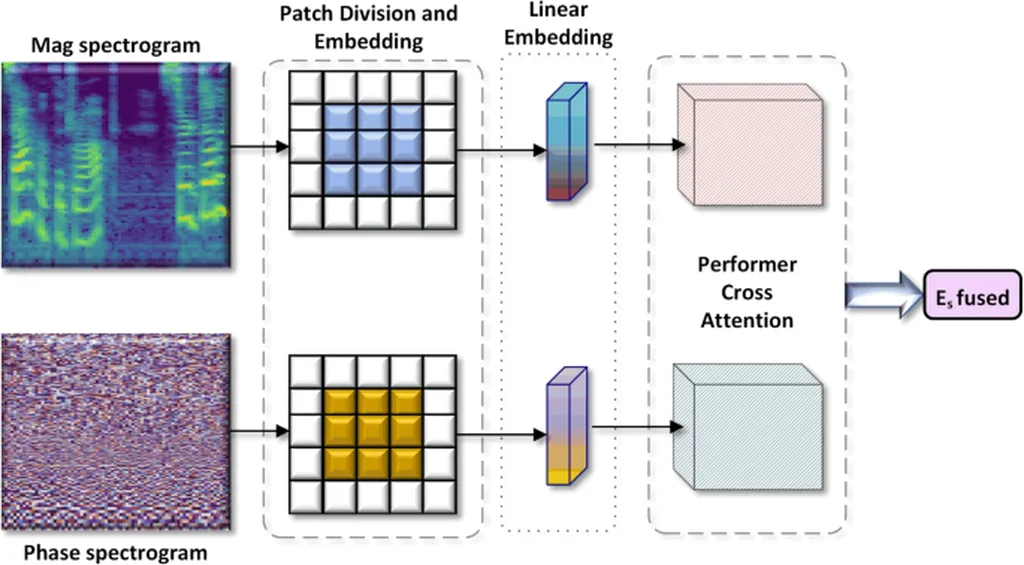
The AaPE method augments standard patch tokens with features produced by a band-limited complex sinusoidal kernel. This kernel uses a two-sided exponential window that dynamically targets alias-prone bands. The frequency and decay parameters of the kernel are estimated from the input, enabling parallel, adaptive subband analysis. The outputs of this analysis are then fused with the standard patch tokens, resulting in a more comprehensive representation of the audio data.
One of the standout features of AaPE is its seamless integration into the masked teacher-student self-supervised learning framework. Additionally, the researchers combined a multi-mask strategy with a contrastive objective to enforce consistency across diverse mask patterns, which helps stabilize training.
The effectiveness of AaPE was demonstrated through pre-training on AudioSet, followed by fine-tuning evaluations across various downstream benchmarks. These benchmarks spanned categories such as environmental sounds and other common audio domains. The results were impressive, with AaPE yielding state-of-the-art performance on a subset of tasks and competitive results across the remainder. Complementary linear probing evaluations mirrored this pattern, showing clear gains on several benchmarks and strong performance elsewhere.
The collective analysis of these results indicates that AaPE effectively mitigates the effects of aliasing without discarding informative high-frequency content. This breakthrough has significant implications for the future of audio representation learning, offering a promising path forward for researchers and developers in the field. As we continue to push the boundaries of what’s possible in audio technology, innovations like AaPE will play a crucial role in shaping the next generation of self-supervised learning models.