
In the world of artificial intelligence and machine learning, the concept of semirings has been a cornerstone for various tasks, from Viterbi decoding to dynamic programming and probabilistic reasoning. These binary semirings, such as the tropical, log, and probability semirings, have been instrumental in modeling pairwise interactions. However, they fall short when it comes to triadic relationships, which are prevalent in many symbolic AI tasks.
Triadic relationships are inherent in subject-predicate-object relations in knowledge graphs, logical rules involving two premises and one conclusion, and multi-entity dependencies in structured decision processes. Current neural architectures often approximate these interactions by flattening or factorizing them into binary components. This approach, while practical, weakens the inductive structure, distorts relational meaning, and reduces interpretability.
Enter the Neural Ternary Semiring (NTS), a novel algebraic framework introduced by researchers Chandrasekhar Gokavarapu and D. Madhusudhana Rao. Grounded in the theory of ternary Gamma-semirings, the NTS replaces the traditional binary product with a native ternary operator implemented by neural networks. This operator is guided by algebraic regularizers that enforce approximate associativity and distributivity, allowing triadic relationships to be represented directly rather than reconstructed from binary interactions.
The researchers have established a soundness result, showing that when algebraic violations vanish during training, the learned operator converges to a valid ternary Gamma-semiring. This finding underscores the mathematical rigor and practical effectiveness of ternary Gamma-semirings in learnable symbolic reasoning.
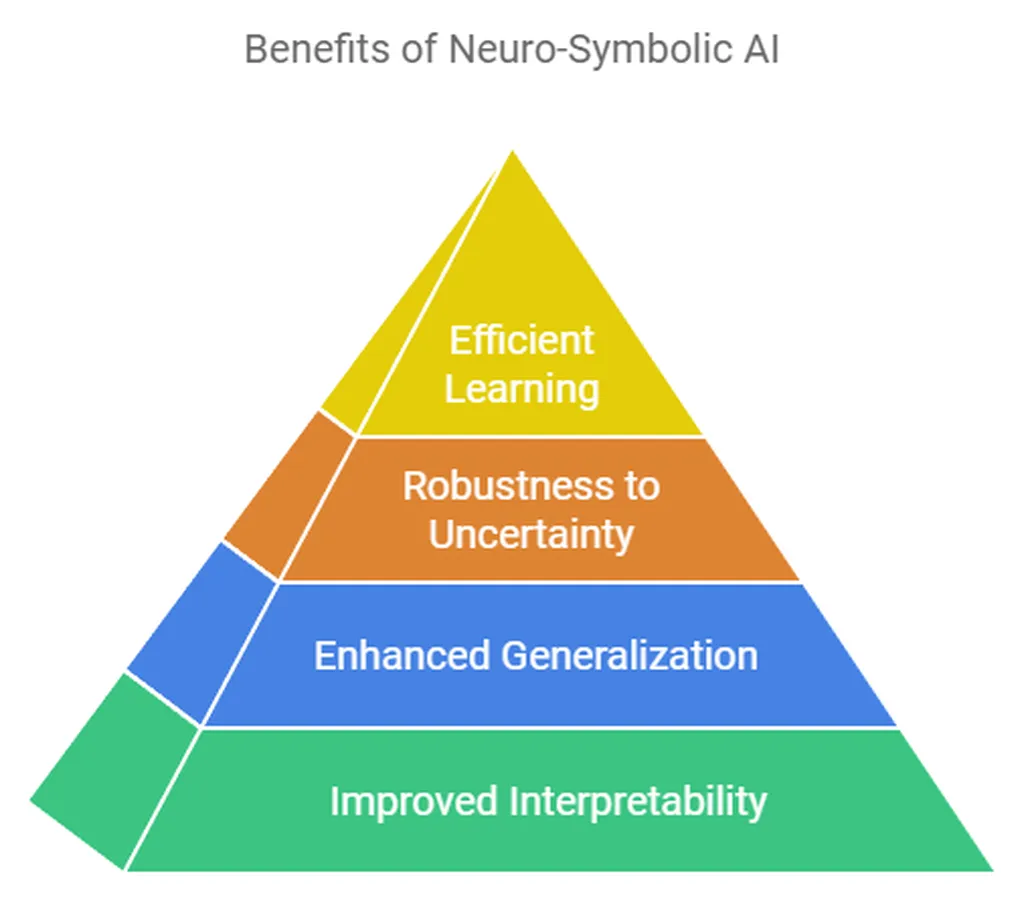
The NTS framework opens up new avenues for triadic reasoning tasks, such as knowledge-graph completion and rule-based inference. By providing a more accurate and interpretable model of triadic relationships, the NTS could significantly enhance the performance and reliability of AI systems in various applications.
In summary, the introduction of the Neural Ternary Semiring represents a significant advancement in the field of symbolic AI. By addressing the limitations of binary semirings, the NTS offers a more comprehensive and accurate framework for modeling complex relationships, paving the way for more sophisticated and interpretable AI systems.