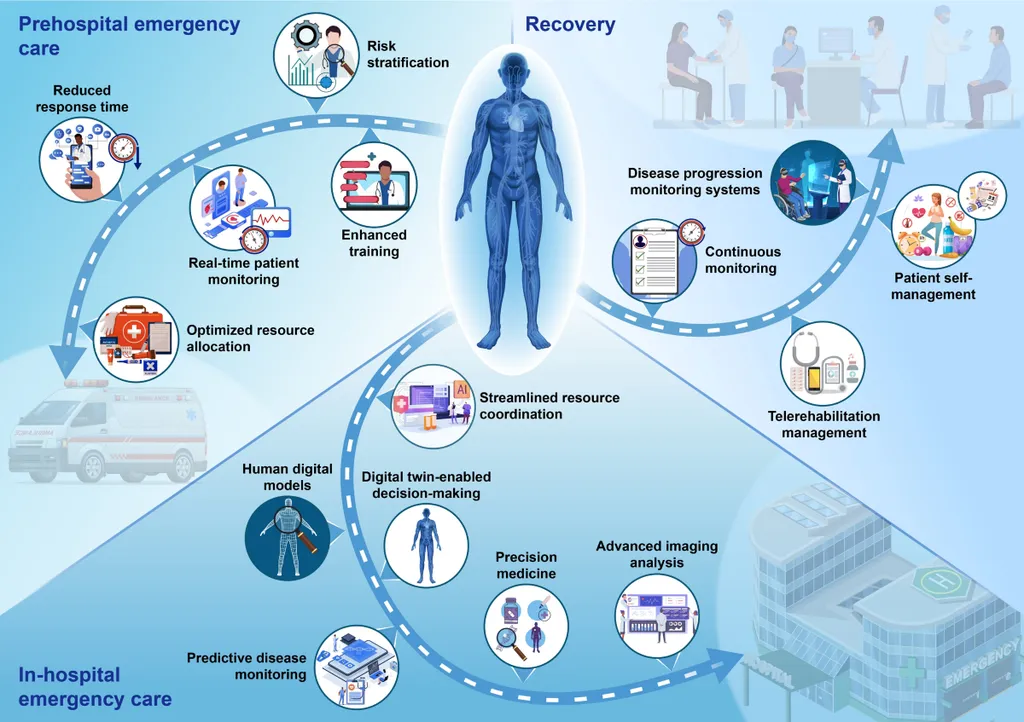
In the high-stakes world of Emergency Medical Services (EMS), first responders often find themselves navigating intense cognitive demands that can significantly impact patient outcomes. To alleviate this burden, researchers have been exploring the potential of AI cognitive assistants, which could act as virtual partners to support real-time data collection and decision-making. A significant step in this direction is the introduction of EgoEMS, a pioneering dataset designed to advance the development of AI tools for EMS professionals.
EgoEMS stands out as the first end-to-end, high-fidelity, multimodal, multiperson dataset that captures over 20 hours of realistic, procedural EMS activities from an egocentric perspective. This comprehensive dataset encompasses 233 simulated emergency scenarios performed by 62 participants, including 46 EMS professionals. Developed in collaboration with EMS experts and aligned with national standards, EgoEMS is a robust resource for training AI systems to assist in emergency medical situations.
The dataset was collected using an open-source, low-cost, and replicable data collection system, ensuring accessibility and scalability for future research. It is meticulously annotated with keysteps, timestamped audio transcripts with speaker diarization, action quality metrics, and bounding boxes with segmentation masks. This level of detail is crucial for developing AI models that can accurately interpret and respond to the dynamic and complex environments typical of emergency medical scenarios.
One of the standout features of EgoEMS is its emphasis on realism. The dataset includes responder-patient interactions that reflect the true dynamics of real-world emergencies, providing a more authentic training ground for AI systems. This realism is essential for ensuring that AI assistants can effectively support EMS professionals in high-pressure situations.
In addition to the dataset, the researchers have also presented a suite of benchmarks for real-time multimodal keystep recognition and action quality estimation. These benchmarks are vital for evaluating the performance of AI support tools and pushing the boundaries of what these systems can achieve. By setting these standards, the research team aims to inspire the broader research community to contribute to the development of intelligent EMS systems.
The ultimate goal of EgoEMS is to improve patient outcomes by providing EMS professionals with reliable AI assistants that can enhance their decision-making capabilities and reduce cognitive load. As the dataset becomes available to researchers, it is expected to catalyze significant advancements in the field of AI-assisted emergency medical care. By leveraging the rich and detailed information provided by EgoEMS, developers can create more sophisticated and effective AI tools that have the potential to save lives in critical situations.
In conclusion, EgoEMS represents a significant milestone in the quest to integrate AI into emergency medical services. Its comprehensive and realistic dataset, coupled with robust benchmarks, offers a powerful foundation for developing AI cognitive assistants that can truly make a difference in the high-stakes world of EMS. As researchers and developers continue to build upon this work, the potential for improved patient outcomes and more effective emergency medical care becomes increasingly tangible.