
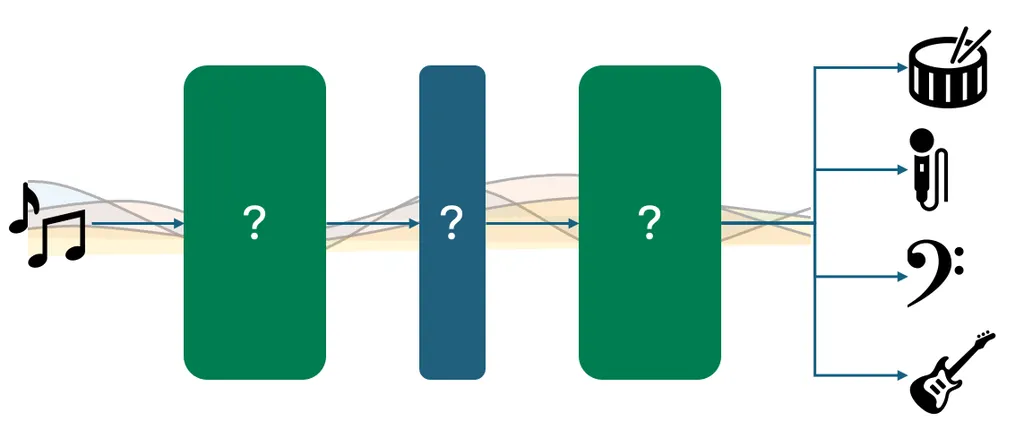
In a significant stride toward addressing the burgeoning challenges posed by AI-generated music, researchers Yumin Kim and Seonghyeon Go have developed a novel approach to detect AI-generated music (AIGM) through structural analysis of music segments. Their work, titled “Segment Transformer: AI-Generated Music Detection via Music Structural Analysis,” presents a transformer-based framework that integrates various pre-trained models to extract musical features from both short and long audio clips, enhancing the accuracy of AIGM detection.
The researchers’ innovative method involves dividing music into segments and learning the inter-segment relationships, which allows for a more comprehensive analysis of the music’s structure. For short audio clips, they utilized self-supervised learning (SSL) models and an audio effect encoder to extract musical features. For longer audio, the segment transformer comes into play, enabling the system to understand the temporal relationships between different segments of the music. This approach not only improves the detection accuracy but also makes the system more robust.
Kim and Go’s work is particularly timely given the rapid advancements in audio and music generation systems within the music information retrieval (MIR) research field. As these technologies become more sophisticated, so do the challenges they present, particularly concerning copyright and authorship. The ability to accurately detect AI-generated music is crucial for protecting the rights of human composers and ensuring that AI-generated content does not infringe upon existing copyrights.
The researchers tested their framework on two datasets: FakeMusicCaps and SONICS. The results were promising, with high accuracy achieved in both short-audio and full-audio detection experiments. This suggests that integrating segment-level musical features into long-range temporal analysis can significantly enhance the performance and robustness of AIGM detection systems.
The practical applications of this research are vast. For music producers and composers, this technology can serve as a safeguard against potential copyright infringements. It can also be used by streaming platforms to monitor and regulate the content they host, ensuring that AI-generated music is properly identified and managed. Furthermore, the ability to detect AI-generated music can help in the development of fair licensing models and policies that respect the rights of both human creators and AI developers.
In conclusion, Kim and Go’s research represents a significant step forward in the field of AI-generated music detection. By leveraging the structural patterns of music segments, their transformer-based framework offers a more accurate and robust method for identifying AI-generated content. This not only addresses current challenges in the music industry but also paves the way for future advancements in music information retrieval and copyright management. Read the original research paper here.