In the quest to combat the global impact of respiratory diseases, researchers have turned to innovative technologies to enhance early detection and diagnosis. A recent study, spearheaded by Asmaa Shati, Ghulam Mubashar Hassan, and Amitava Datta, delves into the potential of acoustic features derived from cough audio signals to identify COVID-19. This research not only addresses the challenges posed by traditional diagnostic methods but also leverages machine learning (ML) to create a more accessible and efficient detection system.
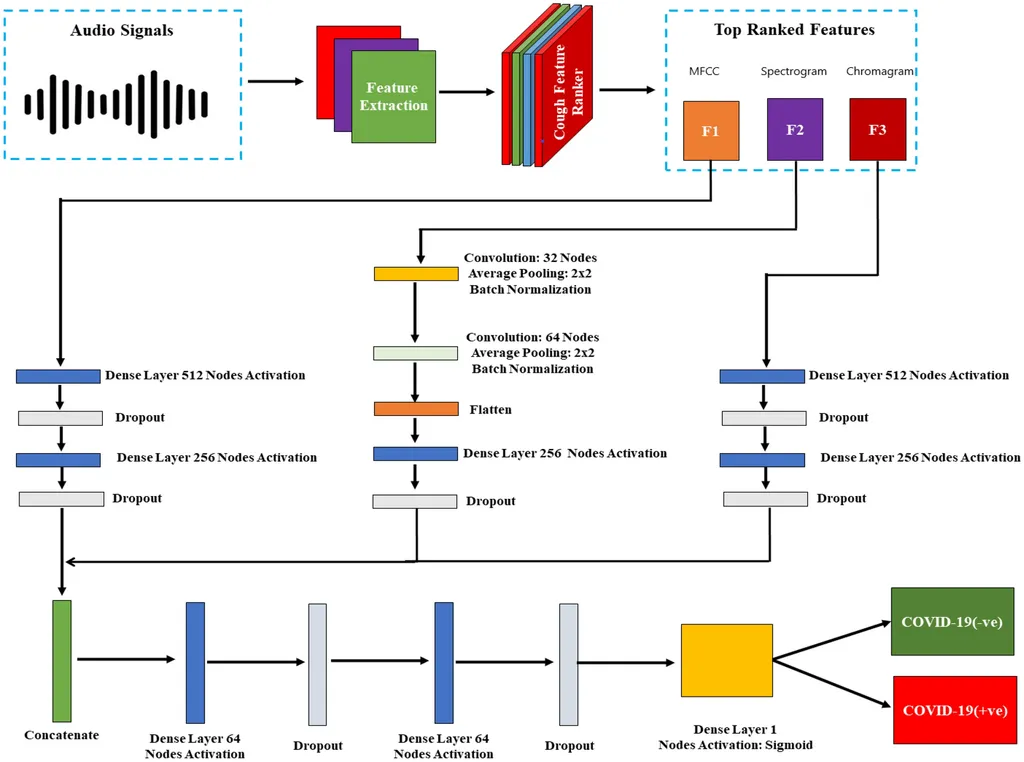
The study focuses on three key feature extraction techniques: Mel Frequency Cepstral Coefficients (MFCC), Chroma, and Spectral Contrast features. These techniques are applied to two machine learning algorithms, Support Vector Machine (SVM) and Multilayer Perceptron (MLP). The goal is to determine which combination of features and algorithms yields the best performance in detecting COVID-19 from cough signals. The research culminates in the proposal of an efficient detection system dubbed CovCepNet, which showcases state-of-the-art classification performance.
The CovCepNet system demonstrates impressive results, achieving an Area Under the Curve (AUC) of 0.843 on the COUGHVID dataset and 0.953 on the Virufy dataset. These figures highlight the system’s efficacy in accurately identifying COVID-19 from cough audio signals. The significance of this research lies in its potential to provide a practical, cost-effective solution that reduces reliance on specialized medical expertise.
The implications of this study extend beyond COVID-19 detection. By automating the analysis of respiratory sounds, the proposed system could revolutionize the diagnosis of various respiratory conditions. This could lead to faster, more accurate diagnoses and ultimately improve patient outcomes. The research also opens the door for further exploration into the acoustic features of respiratory sounds, potentially uncovering new markers for other diseases.
In the realm of audio and music technology, the findings of this study could also have intriguing applications. The techniques used to extract and analyze acoustic features from cough signals are not dissimilar to those used in audio production and music analysis. For instance, the use of MFCC in music information retrieval (MIR) is well-established. This research could inspire new methods for enhancing audio quality, identifying specific sounds, or even creating more intuitive interfaces for audio equipment.
Moreover, the integration of machine learning algorithms in audio analysis could lead to advancements in real-time sound processing. This could be particularly beneficial in live music performances, where immediate feedback and adjustments are crucial. The potential for cross-disciplinary collaboration between medical and audio technology fields is vast, and this study serves as a testament to the innovative solutions that can emerge from such intersections.
In conclusion, the research by Shati, Hassan, and Datta represents a significant step forward in the automated detection of respiratory diseases, particularly COVID-19. The proposed CovCepNet system not only offers a practical solution for medical diagnostics but also opens up new avenues for exploration in the field of audio technology. As we continue to navigate the challenges posed by respiratory diseases, such innovative approaches will be invaluable in enhancing our diagnostic capabilities and improving public health outcomes.