In the rapidly evolving landscape of artificial intelligence, Large Audio-Language Models (LALMs) have made significant strides in various domains such as speech recognition, audio captioning, and auditory question answering. However, a recent study by researchers Zhe Sun, Yujun Cai, Jiayu Yao, and Yiwei Wang has shed light on a critical gap in these models’ capabilities: their inability to perceive spatial dynamics, particularly the motion of sound sources. This revelation has profound implications for the future development of audio technology and its applications in music and audio production.
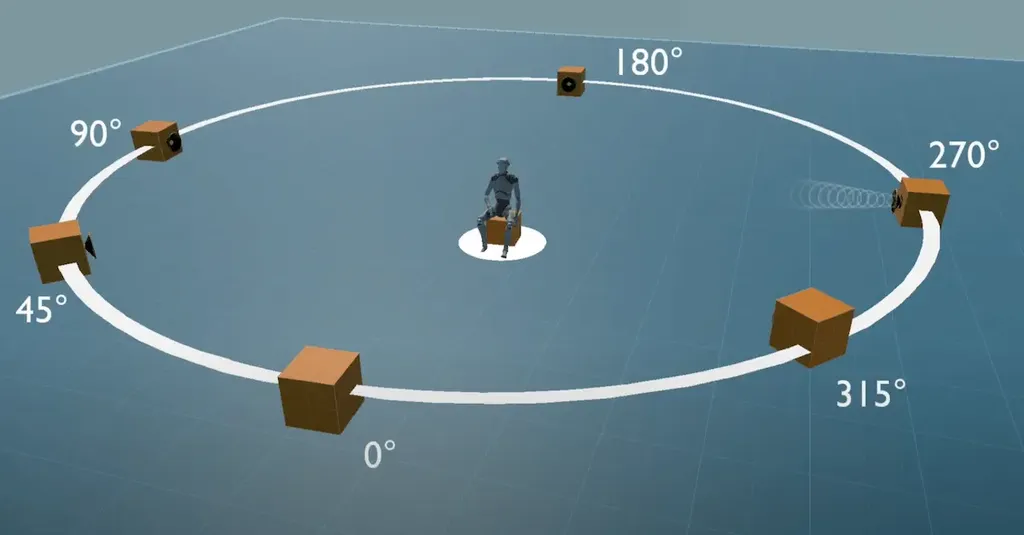
The study introduces AMPBench, the first benchmark designed to evaluate auditory motion understanding in LALMs. AMPBench is a controlled question-answering benchmark that assesses whether these models can infer the direction and trajectory of moving sound sources from binaural audio. Binaural audio, which simulates the way humans hear sound through two ears, is crucial for understanding spatial dynamics. The benchmark’s comprehensive quantitative and qualitative analyses reveal that current models struggle to reliably recognize motion cues or distinguish directional patterns. The average accuracy remains below 50%, indicating a fundamental limitation in auditory spatial reasoning.
The findings highlight a significant disparity between human and model auditory spatial reasoning. Humans can effortlessly perceive the motion and direction of sound sources, a capability that is essential for navigating the world and creating immersive audio experiences. In contrast, LALMs, despite their advanced capabilities in other areas, fall short in this critical aspect. This gap underscores the need for further research and development to enhance spatial cognition in future Audio-Language Models.
The implications of this research extend beyond theoretical understanding. In the realm of music and audio production, the ability to accurately perceive and manipulate spatial dynamics is paramount. From creating realistic soundscapes in video games and virtual reality to producing immersive audio experiences in concerts and live performances, the applications are vast. The limitations identified in the study suggest that current LALMs may not be fully equipped to meet these demands, highlighting the need for advancements in auditory spatial reasoning.
Moreover, the study provides a diagnostic tool for evaluating and improving the spatial cognition of LALMs. By identifying the specific areas where these models falter, researchers can develop targeted strategies to enhance their performance. This could involve incorporating more sophisticated algorithms, training models with more diverse and complex audio datasets, or exploring new architectures that better capture the nuances of spatial dynamics.
In conclusion, the study by Zhe Sun and his colleagues offers valuable insights into the current limitations of Large Audio-Language Models in perceiving spatial dynamics. It underscores the need for continued research and innovation to bridge the gap between human and model auditory spatial reasoning. As we move towards an increasingly immersive and interactive audio landscape, the ability to accurately perceive and manipulate the motion of sound sources will be crucial. The findings of this study provide a roadmap for future developments in this exciting and rapidly evolving field.