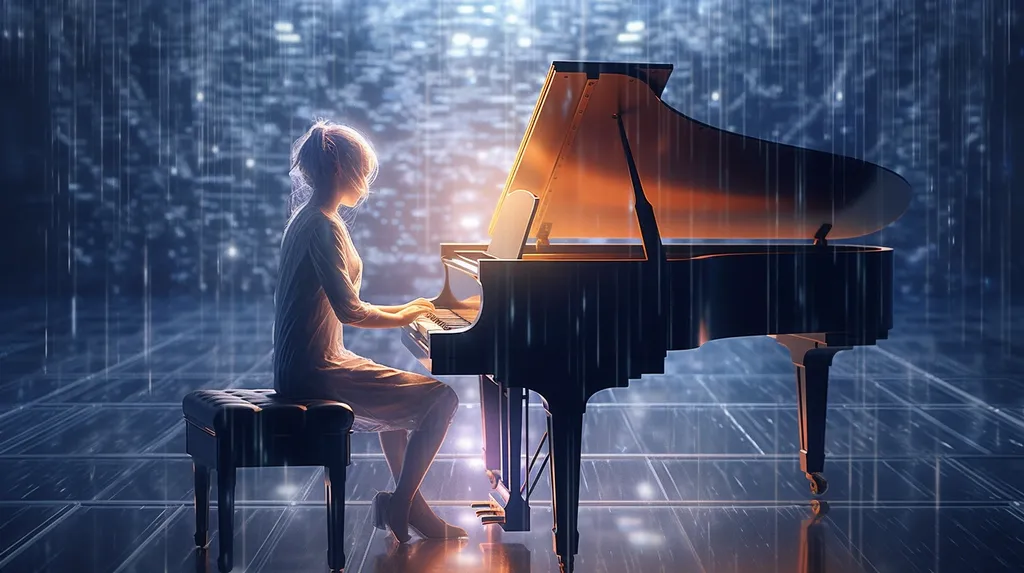
In the rapidly evolving world of music technology, a groundbreaking development is bridging the gap between human creativity and artificial intelligence. Researchers Louis Bradshaw, Alexander Spangher, Stella Biderman, and Simon Colton have introduced Aria-Duet, an interactive system that facilitates a real-time musical duet between a human pianist and Aria, a state-of-the-art generative model. This innovation addresses a significant hurdle in the adoption of AI in music composition: the disconnect between the asynchronous, text-prompting workflow of generative models and the embodied, responsive nature of instrumental performance.
Aria-Duet leverages a Yamaha Disklavier, a high-tech piano that can both play and record performances, as a shared physical interface. The system enables a turn-taking collaboration where the human pianist performs, signals a handover, and the AI model generates a coherent continuation, which is then performed acoustically on the piano. This low-latency interaction creates a seamless, interactive experience that mimics the dynamic of a live musical duet.
The technical architecture behind Aria-Duet is impressive, but the real magic lies in its ability to engage in musically sophisticated dialogue. From a musicological perspective, the system’s output demonstrates a remarkable capacity to maintain stylistic semantics and develop coherent phrasal ideas. This means that the AI doesn’t just generate random notes; it understands and responds to the musical context, creating a meaningful and coherent musical conversation.
The implications of this research are vast. For musicians, Aria-Duet opens up new avenues for creativity and collaboration. Imagine a pianist composing a melody and the AI responding with a harmonically rich accompaniment, or a jazz musician improvising a solo and the AI matching and elevating the improvisation. This technology could also be a powerful tool for music education, providing students with an interactive partner to practice and learn from.
Moreover, Aria-Duet could revolutionize the way music is produced. In a studio setting, the AI could act as a virtual session musician, offering instant, high-quality contributions to a composition. It could also serve as a source of inspiration, generating ideas that human musicians might not have considered, thereby enriching the creative process.
In essence, Aria-Duet represents a significant step forward in human-AI co-creation. It’s not just about the AI generating music; it’s about the AI and the human musician creating something together, in real-time, through a shared interface. This research opens a promising new path for the future of music, where human creativity and artificial intelligence collaborate to produce something truly extraordinary. As the researchers continue to refine and develop Aria-Duet, we can expect to see even more sophisticated and nuanced musical dialogues between humans and AI, heralding a new era in the world of music.